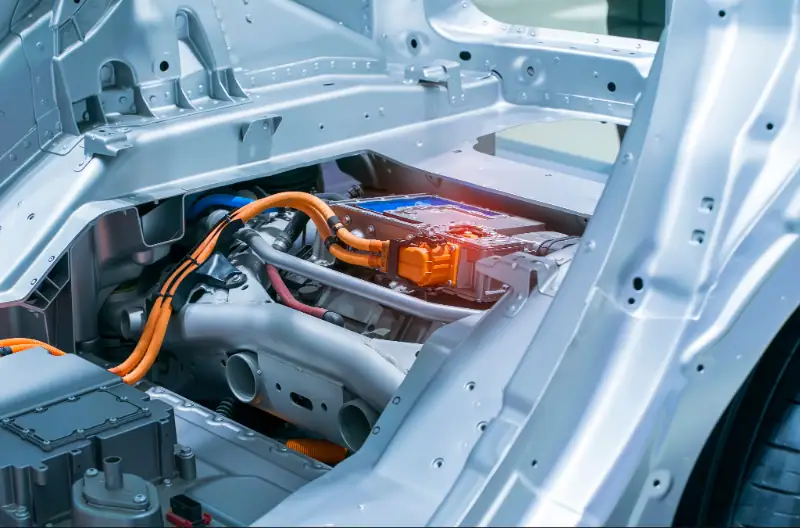
Thermal management is critical to the performance and reliability of electric vehicles because the battery pack powers every aspect of the vehicle, generating large amounts of heat in the process. Meanwhile, a battery management system (BMS) regulates charge, discharge, and protection cycles, while advanced materials and designs reduce stress and extend EV battery lifespan.
Because the heat is concentrated in a small area, the risks of thermal runaway, damage to vehicle components, and occupant safety grow. Here we’ll look at the sources of heat from battery packs and BMSs, the potential risks from too much heat, and cooling strategies.
Battery Pack Heat Sources
Battery packs generate heat during normal operation, but intense charging, high-power discharges, and fast acceleration increase heat production significantly. Without innovative materials and designs, hot spots build up inside densely packed battery cells, shortening cycle life while increasing risk factors.
Electrical engineers who understand these dynamics create safer, more reliable systems by preventing thermal runaway caused by a combination of heat sources:
- Electrochemical reactions inside cells during charging and discharging.
- Electrical resistance across interconnects and busbars.
- Heat transfer from neighboring components, like inverters and motors.
- Environmental factors (e.g., ambient temperature and solar loading).
Our team helps OEMs anticipate these factors by designing electric vehicle cooling strategies that balance safety with performance and efficiency.
BMS Heat Generation
A BMS monitors and regulates the battery pack, but it also introduces new thermal challenges itself. The high-speed processors, sensors, and switching circuits in a BMS all generate heat during critical operations. Engineers must address these additional heat sources, or the BMS itself becomes a failure point that undermines system safety and reliability.
Key BMS-related heat challenges include:
- Power electronics that dissipate energy during high-frequency switching.
- Voltage and current sensors heating over extended monitoring cycles.
- Control boards experiencing uneven thermal loading.
- Limited physical space that inhibits airflow and restricts heat spreading materials.
That’s why T-Global provides solutions to cool both the battery pack and BMS electronics. Only by controlling both can EV manufacturers ensure monitoring and protection systems themselves don’t become weak links.
Multi-Factor Thermal Risks
Batteries and electronics share more than just housing — they share the risks associated with thermal runaway and sporadic heating. To prevent cascading failures, engineers must address thermal challenges systemwide. Effective EV battery thermal management requires materials and layouts that mitigate hazards before they escalate.
Some of the most critical shared risks between battery packs and the BMS are:
- Reduced EV battery lifespan when thermal gradients introduce stress unevenly across battery cells.
- Electrical imbalance that stresses the BMS and shortens lifespan of various components.
- Prolonged heat exposure that accelerates aging for adhesives, seals, and insulation.
- Catastrophic system failure, if thermal runaway prevention measures fail.
Cooling Strategies/How to Co-Design Thermal Paths
At T-Global, we protect mission-critical EV components against these risks with a range of thermal management products including thermal pads, phase change material, thermal tape, grease, and putty. Each of these is part of a comprehensive plan for thermal management, because no single method or product can address all the heat sources in a vehicle. Careful integration of these materials in critical applications greatly improves heat dissipation and cooling capabilities.
Some sample applications include (but are not limited to):
- Integrating thermal interface materials (TIMs) that spread heat across cells evenly.
- Liquid and air-cooled channels to manage high-power operation.
- Using phase-change materials to regulate transient spikes in temperature, which can lead to up to a 46% reduction in fluctuations and increase heat dissipation efficiency.
- Aligning battery pack and BMS cooling paths for shared thermal stability.
Our products and team of experts help OEMs improve system safety, extend EV battery lifespan, and deliver vehicles that perform consistently in any environment.
Contact T-Global for EV Thermal Management Solutions
EVs generate heat from multiple sources, so it’s critical to address as many as possible with optimal materials. At T-Global, we provide innovative products and materials for thermal management, heat dissipation, and reducing energy consumption.
Contact us to request a quote or a sample for your next EV battery pack or BMS project.