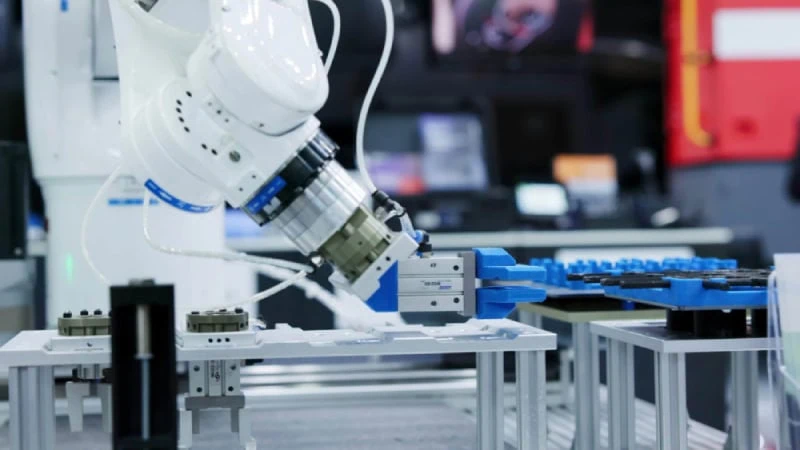
The fourth industrial revolution, also known as Industry 4.0, enables the use of smarter technologies, real-time data analysis, and advanced AI capabilities. The need for effective thermal management in automation and robotics is a primary consideration in this new era. These computers and microprocessors can generate substantial amounts of heat, which adds to the heat already generated by robots and other automation equipment.
Using advanced thermal management and industrial robotics cooling systems can help companies keep pace with modern automation and robotic equipment. Keep reading to learn more about thermal challenges in smart factories and the importance of high-quality industrial cooling systems.
Industrial Automation: The Brains Behind Smart Factories
In factory settings, automation can be used to supplement, augment, or even replace human labor to improve efficiency, product quality, and safety. Automated equipment like conveyors, sensor-driven quality inspection equipment, material handling equipment, automated CNC and welding fixturing, and even safety locking mechanisms can help maintain steady throughput and keep workers safe. These often include integrated software that serves as the “brains” of the equipment.
All of this computing generates heat, which is damaging to equipment, raw materials, and finished products. Some of the biggest problems associated with this excess heat are:
- High heat density. Modern automation equipment offers extreme power in a compact space. While good for performance, the heat becomes concentrated quickly and can easily overwhelm traditional cooling methods.
- Thermal runaway. Heat density can lead to thermal runaway, which is a rapid, uncontrolled temperature increase that can lead to component failure. In these situations, thermal throttling is used to protect equipment, with a subsequent reduction in performance.
- Reduced reliability. Thermal stress from uncontrolled heat accelerates wear on components, increasing the risk of material breakdown and component failure and unplanned downtime.
Industrial Robotics: The Working Hands of Modern Industry
Robotics are often the arms and hands of a task, process, or operation like welding, painting, or manipulating tools and parts. Industrial robots are programmable and many, including smaller robots or cobots (collaborative robots), can be “trained” on the fly when work instructions need updating. On-board actuators, microprocessors, and the larger computer systems that oversee robots and analyze performance data also generate considerable heat. What problems will industrial robotics contribute if there’s no proper thermal management?
- Performance degradation. Thermal stress can lead to inefficient operation and poor robotics thermal control, particularly if throttling is required.
- Component failure. Without proper thermal management, radiant heat, ambient heat, and heat from equipment can cause premature failure of robotic components. Damage can be due to melting or charring of external arm and gripper components, or heat damage to internal circuitry and wiring.
- Reduced accuracy. Extreme temperature changes can also result in thermal drift, which can negatively affect a robot’s accuracy and precision.
- Safety issues. Overheating can even pose safety issues, such as fires or component failure in critical systems.
Thermal Management: The Hidden Backbone of Reliability
Smart technologies are integral to the efficiency and productivity of modern automation and robotic equipment in factories, warehouses, and other industrial facilities, as well as its thermal management. Given the thermal challenges present, effective heat management is essential for ongoing performance and productivity. The core challenge of doing thermal management is the limited space and harsh industrial environments make passive cooling less effective for sudden heat spikes. A combined approach—integrating passive elements with predictive thermal design and strategic component placement—helps maintain stable temperatures even under variable loads. Some common thermal management solutions used in smart factories include:
- Active cooling systems. Active cooling refers to powered cooling systems that dissipate heat. Liquid cooling systems circulate coolant, absorb heat, and carry it away from critical components. Air cooling uses fans to force air over critical components, effectively transferring the excess heat.
- Passive cooling systems. These do not require external power, such as heat sinks, thermal pads, and thermal putty. These systems also rely on optimized equipment layouts to promote airflow and heat dissipation. At the component level—especially in control boards for high-performance robotic systems—design features like thermal vias (strategically placed, heat-conductive holes in PCBs) help transfer heat away from critical electronics, complementing the overall passive cooling strategy.
- Protective gear. To protect robotics and other automated equipment, thermal insulation and protective covers can also be used to shield robots from radiant heat.
Smarter, Greener Factories With Smarter Cooling
Investing in thermal management is essential to the success of factories in the age of Industry 4.0. Well-planned and properly executed thermal management strategies help improve factory operations by boosting equipment efficiency and lifespan, reducing energy consumption, and minimizing environmental impact through heat control and energy efficiency. With smart cooling and thermal management solutions in place, you can help ensure that your factory is doing its part to reduce energy usage and pave the way for a greener future in manufacturing while improving operational reliability.
T-Global USA Offers Optimal Thermal Solutions
T-Global USA provides advanced thermal solutions for robots and automated equipment, including heat sinks and spreaders, thermal greases (pastes) and putties, thermal pads, heat pipes, vapor chambers, and custom solutions. With over 20 years of experience working with customers in different industries, our team can provide guidance and products that are best-suited to your operations and your unique requirements.
Contact our team today to obtain a quote for your application!